 DatumForms
For research agencies & corporate teams
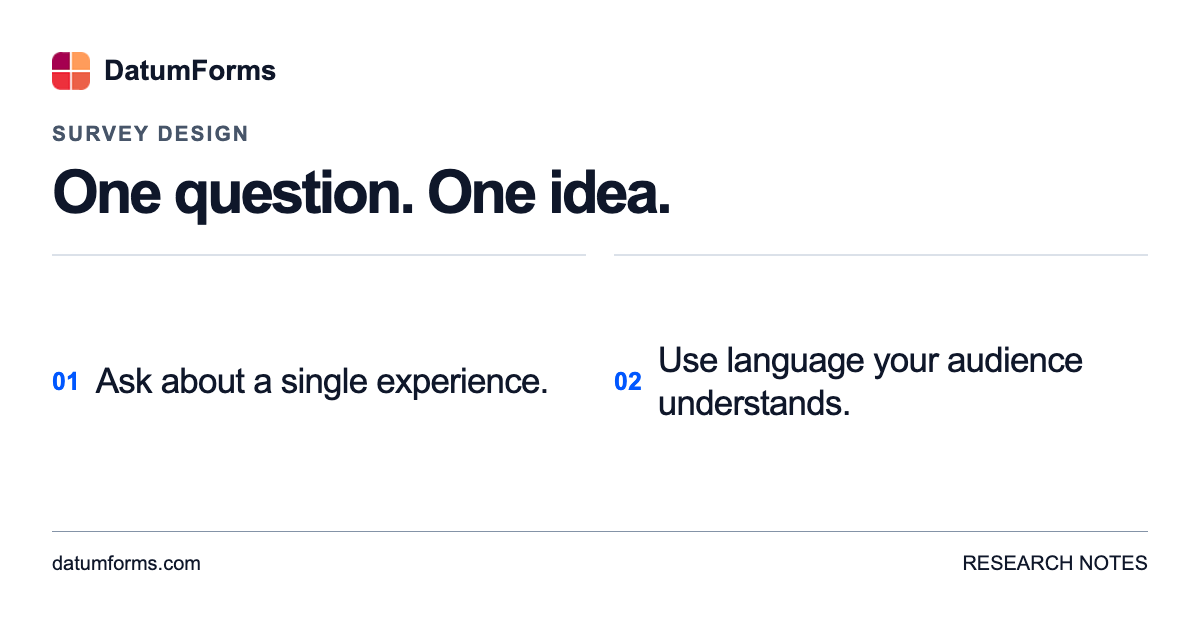
One question, one idea: improve a questionnaire item
Use an original price-and-service example to review ambiguous survey wording and give each answer a clearer purpose.
TL;DR
- A single rating cannot reliably explain two experiences that a person might judge differently.
- Split combined ideas, then check wording, time references and answer options.
- Try revised questions with the intended audience and document changes to repeat studies.
Imagine a questionnaire asks:
How satisfied were you with our prices and the service you received?
What should a customer select if the service was helpful but the price felt too high? A single rating leaves the research team unsure which experience the person was judging.
This is often called a double-barrelled (also spelled double-barreled) survey question: one item asks a person to judge more than one thing.
Separate the ideas
For a hypothetical review exercise, split the item into two questions:
How satisfied were you with the price you paid on your most recent visit?
How satisfied were you with the service you received on your most recent visit?
These are examples to review, not a universal questionnaire ready for every study. The intended respondents, their experience and the research brief should determine the wording and answer choices.
Separating the questions gives the team two distinct answers to discuss. It does not, by itself, establish why a respondent gave either answer.
Check the words as well as the structure
Look for terms that may mean different things to different people. Does “service” mean staff helpfulness, waiting time, delivery or something else in this study? Does “recently” refer to this week, this month or the respondent’s last interaction?
Use a relevant time reference and language the intended audience can understand. For research spanning different markets, do not assume that an English phrase will carry the same meaning everywhere. Review the wording with people familiar with each intended audience.
Pew Research Center’s question-writing guidance discusses wording, questions that combine more than one idea, and the importance of pretesting.
Try a quick editing exercise
Take one item from a draft questionnaire. Underline each experience, behaviour or opinion it asks the person to judge. If the item contains more than one, ask whether a person could reasonably answer the parts differently.
Then revise the question and try it with relevant people before launch. Ask what they thought the item meant and how they chose an answer. Keep notes on the changes.
If you are comparing results with an earlier survey, consider how a wording change affects that comparison. Clearer wording can be worthwhile, but a changed item should not silently be treated as identical to the old one.
Compare the original and revised items
This table is a questionnaire-review example, not empirical survey data. The suggested revisions still need to fit the study and be tried with the intended respondents.
| Item | What a reviewer should check | Possible revision |
|---|---|---|
| Rate our price and service | A person may judge the two experiences differently | Ask about the price and service separately |
| Was collection quick and convenient? | Speed and convenience may mean different things | Decide which concept the brief needs, or ask two focused questions |
| Are you satisfied with our recent improvements? | The respondent may not know what changed | Specify the experience or change the person can reasonably evaluate |
Splitting every sentence mechanically is not the goal. Start with what you need to learn. Sometimes the right correction is to remove a concept that does not belong in the brief, rather than adding another question.
Choose answer options that fit the question
After revising an item, read its response options again. An answer scale that made sense for a broad satisfaction question may not fit a question about frequency or a particular event. Ask whether the person has the experience needed to answer and whether the options let them express a relevant response.
For the hypothetical price-and-service example, the team would need to decide whether satisfaction is the concept it wants to measure in both items. It should also consider how to handle a person who did not pay the price or did not interact with the service being discussed. Do not simply copy the same scale into both questions and assume the review is complete.
Keep a small revision log
Record the original wording, the revised wording, the reason for the change and what you learned when trying it with relevant people. A practical review question is: “What did you think this item was asking?” Ask that without telling the person what they were supposed to understand.
If the item is part of a recurring study, keep the earlier wording alongside the new version. A clearer item can improve the next questionnaire while also changing what a comparison with earlier answers means. Make that trade-off visible in the review.
Explore DatumForms when your team is ready to build and review the questionnaire.
For the purpose behind a question, return to the research brief template. It helps decide which ideas belong in the questionnaire.
After revising individual items, use a respondent-experience checklist to review how they work together.