 DatumForms
For research agencies & corporate teams
Turn survey results into a business decision: a review worksheet
Use a practical worksheet to connect a survey finding, its limits, a proposed action and a follow-up measure without overstating the evidence.
TL;DR
- Return to the decision the research was designed to inform.
- Keep the observed result separate from explanations and limits.
- Assign a next action, owner and follow-up measure.
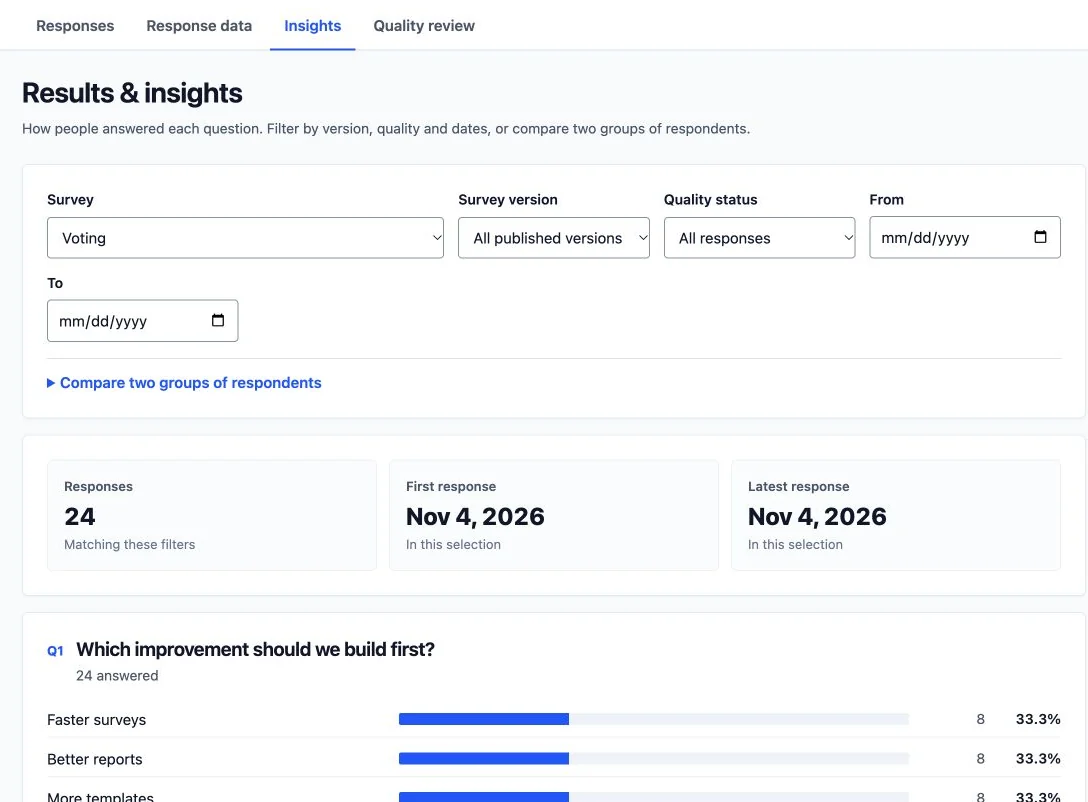
A survey can inform a decision when the team connects the question it asked, the people it reached and the action it can take. A chart alone does not supply that connection. Use this worksheet when reviewing a client report or preparing an internal decision meeting.
The product screenshot shows a sample feature-review questionnaire. The appointment example below is hypothetical; it illustrates reasoning, not a DatumForms customer result or a claim about a wider population.
Start with the decision and the eligible responses
Write the pending decision in one sentence. For a hypothetical service team, it might be: should we test clearer appointment instructions before changing staffing? Identify what evidence would support that choice and what the survey cannot answer.
In DatumForms, select the intended project and survey in Results. Check submission status, filters, field dates and survey versions before calculating a result. Keep changed question definitions separate. Explain any quality exclusions and missing answers.
The versioned-results guide explains the controls. The research-brief guide helps connect the original research question to the decision.
Separate what respondents said from why it happened
Suppose some eligible respondents mention confusing arrival instructions. That is an observation about those responses. The claim that the instructions caused missed appointments is an explanation that needs additional evidence.
Review the exact wording and answer options. Read open comments in context and record how they were grouped. A count of comments is not automatically a count of all customers experiencing a problem, especially when commenting was optional.
Use three headings in the review: Observed, Possible explanations, and What we still need to check. See separating observation from explanation .
Complete the decision worksheet
| Review item | What to record | Hypothetical appointment example |
|---|---|---|
| Decision | The action the team can choose | Test clearer arrival instructions |
| Evidence | The question, eligible answers and finding | Some respondents describe uncertainty about where to go |
| Limits | Coverage, missing answers, timing and design | The survey reached recent respondents, not every appointment holder |
| Alternatives | Other explanations to investigate | Signage, reminder timing or a change in appointment location |
| Next action | A bounded change and responsible owner | The service lead drafts revised instructions for a pilot |
| Follow-up | A measure and review point | Review navigation questions and operational records after the pilot |
Replace every example with the actual study details. Include the denominator whenever you present a proportion, and state whether it describes all eligible submitted answers or a subset.
Choose an action that matches the strength of the evidence
A small pilot, further interviews or checking operational records may be more defensible than an immediate organization-wide change. Consider the cost of a wrong decision, whether important groups were missing and what additional information is feasible to collect.
An opt-in sample does not become representative because it is large or quota-balanced. Do not add a classical margin of error unless the sampling design supports it. The sampling-bias guide provides a method-disclosure checklist.
Make the follow-up interpretable
Assign an owner and define when the team will review the change. Keep the wording, audience and collection approach comparable where the aim is to track a measure over time. Record changes that affect comparability.
If the follow-up improves, consider other changes that happened at the same time. A before-and-after survey without an appropriate comparison does not isolate the effect of the intervention.
Finish the report with a decision record: the action selected, the evidence considered, the limitations accepted and the next review. This makes the survey useful without asking it to prove more than its design can support.