 DatumForms
For research agencies & corporate teams
Separate survey observations from explanations
A simple reporting exercise to keep respondent observations, possible explanations and research limits distinct.
TL;DR
- Keep the reported answer separate from an explanation you want to investigate.
- Describe whose responses are included and how they were collected.
- Use an observed–scope–unresolved–next-step template to structure the findings discussion.
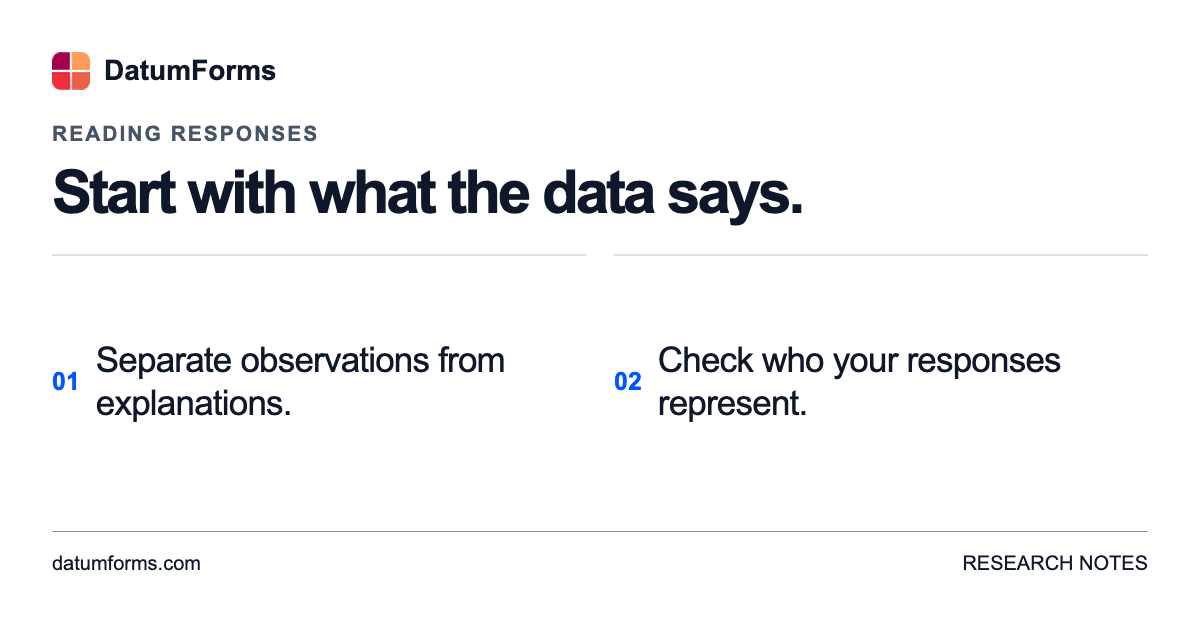
A survey finding can start a useful discussion without answering every question in that discussion. One way to keep the conversation clear is to separate what respondents reported from the explanation the team wants to investigate.
Consider a hypothetical customer survey in which some respondents describe collection as difficult. This is an illustration, not a DatumForms customer result or a claim about the prevalence of that experience.
Write the observation first
Begin with the answer people actually gave. Keep the wording close to the question and response options, and identify the relevant respondents and period.
For the hypothetical example, the observation might be: “Some respondents who used collection described that part of their most recent visit as difficult.” A real report would need the actual question, response counts and the study context rather than the word “some.”
Avoid adding an explanation to that sentence before you have evidence for it.
Name the explanation as a question
The team might suspect waiting time, unclear directions or a problem with collection messages. Those possibilities can guide the next investigation, but the survey answer in this example does not distinguish between them.
Write them separately: “We should investigate whether waiting time or instructions contributed to the reported difficulty.” This gives the team a practical next step while keeping the observation intact.
Keep the study’s reach visible
Record who was invited, who responded and how responses were collected. Ask whether the people who answered support the conclusion the team wants to make. A large response count alone does not establish that an opt-in sample represents a wider population.
AAPOR’s survey-research guidance provides background on design, collection and reporting. Use the method and its limitations when describing the findings; do not attach a conventional margin-of-error claim to an opt-in panel without an appropriate methodological basis.
Use a short reporting template
Bring four statements to the review meeting:
- Observed: What did respondents report?
- Scope: Whose answers are included, and how were they collected?
- Unresolved: What does this result leave uncertain?
- Next step: What should the team check or decide next?
This structure makes it easier to discuss an unexpected result without turning an early interpretation into a settled conclusion.
Compare a finding with an interpretation
The following examples are hypothetical. They contain no customer metrics and should not be read as findings from a DatumForms study.
| Statement | What it does | How to handle it in the discussion |
|---|---|---|
| Respondents described collection as difficult | Describes an answer in the example | Add the actual question, counts and relevant respondent group in a real report |
| Waiting time caused the difficulty | Adds a causal explanation | Treat it as something to investigate unless the study supports that conclusion |
| We should examine waiting time and instructions | Proposes a next step | Name the additional evidence needed and who will review it |
Keeping these statements separate does not make the discussion less useful. It lets the team agree on an observation while still considering different explanations and next steps.
Make the scope easy to find
Put the respondent group, collection period and method close to the result they describe. If a chart or paragraph is copied into a presentation, the scope should travel with it. Do not rely on a methodological note that nobody can find during the meeting.
If the team compares subgroups, check which answers belong in each comparison and whether the question has the same meaning for those groups. If it compares different survey waves, review changes to wording, collection and the people who answered before describing a trend.
For an agency, discuss those limits with the client before the report is treated as evidence for a wider claim. For an internal team, make them visible to the person responsible for the decision.
Turn uncertainty into a useful next question
End with a specific unresolved question rather than a general request for “more research.” In the example, that might mean examining what respondents understood by collection difficulty or looking at relevant operational information alongside the survey. Choose the next step according to the gap in the evidence.
Finally, give that next step an owner. A findings meeting is easier to follow when the team can distinguish the answer it has, the explanation it is considering and the work it has agreed to do next. Discuss your research brief if you are planning a new study.
Keep the original scope beside the findings; the research brief template can help explain what the study set out to learn.
Use the survey project workflow to identify who owns the next handoff.