 DatumForms
For research agencies & corporate teams
Plan a survey workflow from brief to review
Connect the research brief, questionnaire, audience, collection and response review in a practical business workflow.
TL;DR
- Connect the brief, questionnaire review, audience planning, collection and findings discussion.
- Give each stage an owner and a clear handoff.
- An audience estimate is a planning step; check launch, publication and funding requirements separately.
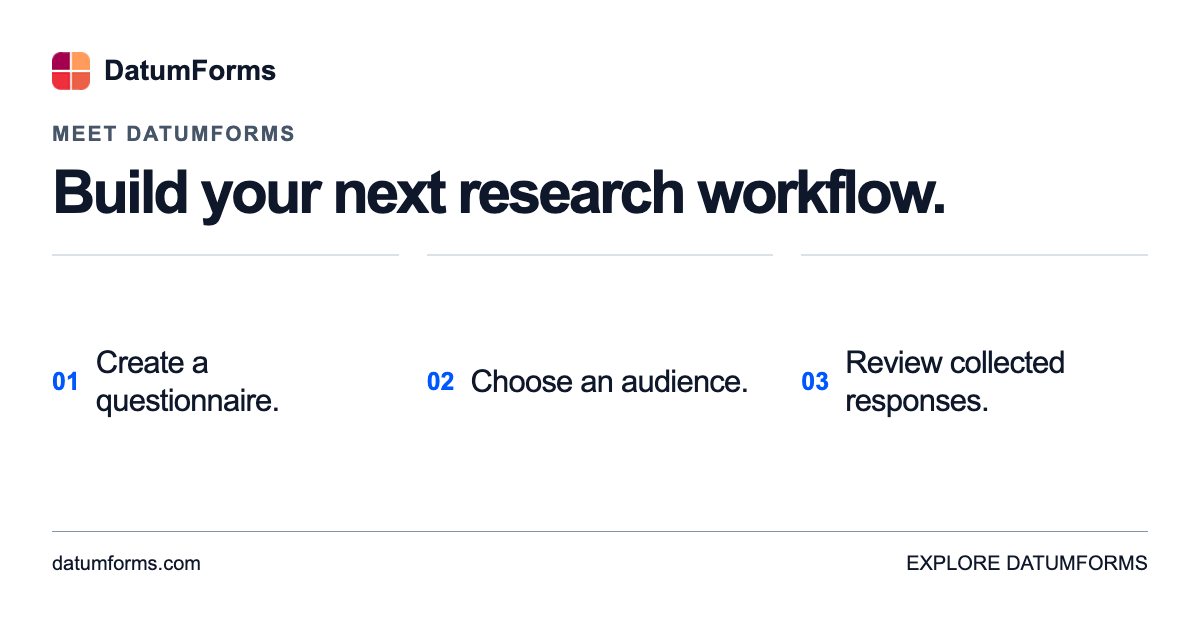
A survey project involves more than writing questions. Someone must agree on the brief, review the questionnaire, decide how to reach relevant people and make sense of the responses.
For a research agency or corporate research team, it helps to give each stage an owner and a clear handoff. Here is a working sequence to discuss before starting your next project.
1. Agree on the brief
Name the decision the study should inform and the information you need. Record the intended audience and who will use the findings. Keep this brief available when reviewers suggest extra questions, so the team can decide whether each addition belongs in the study.
2. Build and review the questionnaire
DatumForms provides survey authoring and a publication workflow. Organize the questionnaire, then review the respondent experience before publishing. Check wording, answer options and any alternate routes relevant to the study.
Keep a record of review decisions. If an agency is working with a client, agree who can approve the questionnaire rather than leaving approval implicit in an email conversation.
3. Plan how to reach the audience
Write down who should take part and what would make a response relevant to the research question. Decide how the survey will reach those people.
For panel research in DatumForms, teams can define an audience, review an estimate and attach recruitment to a survey. An estimate is a planning step; it is not proof that recruitment has started or that a particular audience is currently available. Check publication, funding and study requirements before a commercial launch.
4. Review collection and responses
DatumForms brings collected responses into a reporting workflow. Agree who will monitor the study and how the team will review the information it receives.
Do not wait until the final discussion to consider what the responses can support. Keep the audience definition and collection approach beside the findings so the team can describe the study accurately.
5. Make the next handoff explicit
Close the project discussion with the finding, its limits and the next decision or investigation. Record who owns that next step.
To explore the software for your team, compare the current plans or discuss a research brief with DatumForms.
Put the handoffs in one place
This is a suggested project-planning table. It describes team responsibilities, not automatic features or service guarantees. Adapt it to how your organisation works.
| Stage | Useful handoff | Decision to make before moving on |
|---|---|---|
| Brief | Agreed objective, audience and use of findings | Does the proposed study address the decision? |
| Questionnaire | Reviewed questions, options and routes | Is the respondent experience ready for publication? |
| Audience plan | Recruitment approach and applicable estimate | Are the study’s launch requirements understood? |
| Collection | Clear responsibilities and progress review | What requires attention while responses arrive? |
| Findings | Observations, scope, limits and next step | Who owns the next decision or investigation? |
A smaller team may give several stages to one person. A larger agency project may involve the client, a questionnaire author and separate reviewers. The useful part is knowing what each person needs from the previous stage.
Keep commercial requirements separate from research approval
An approved questionnaire does not by itself establish that recruitment is funded or that a required project purchase has been completed. Likewise, a payment does not establish that the questionnaire has passed review. Confirm each applicable requirement before launch.
Use the current pricing page and the project’s actual configuration when discussing costs. Do not turn an estimate or an earlier project’s terms into a promise for a new study. If the audience or questionnaire changes, revisit the affected planning assumptions.
Make review notes easy to follow
For each handoff, write down what was agreed, what remains unresolved and who acts next. A short note can prevent an internal project sponsor from assuming that collection has started when the team is still reviewing the questionnaire.
In the findings discussion, return to the original brief. Explain which questions the responses help address and which questions still need another kind of investigation. This keeps the workflow connected to the business decision that started it.
DatumForms supports the survey work within this process; the team still owns the research design, interpretation and decisions. Discuss your next research workflow if you want to explore how it fits your project.
Use the respondent-experience checklist as part of the questionnaire handoff.
Keep the research brief beside the interpretation of findings when the team discusses its next decision.