 DatumForms
For research agencies & corporate teams
World Television Day: designing a media consumption survey
Design media consumption questions that distinguish platform, device, viewing frequency and recall period without claiming audience ratings.
TL;DR
- Define what counts as viewing before collecting answers.
- Separate unaided recall from prompted channel or programme lists.
- Self-reported use is not automatically a measured audience rating.
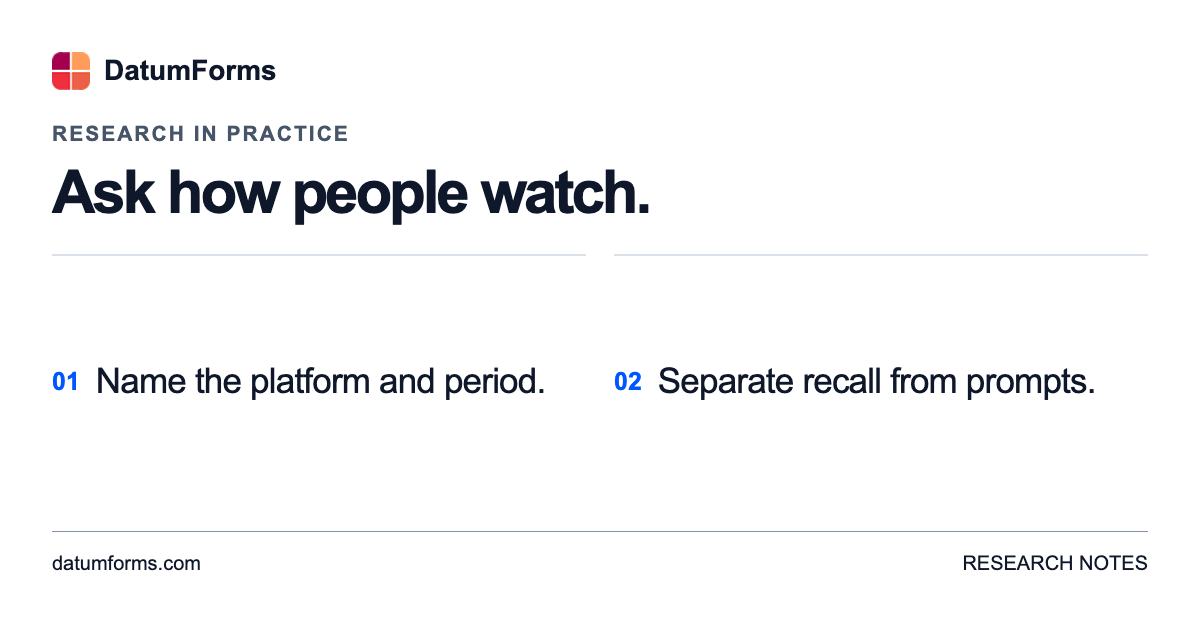
World Television Day is observed on November 21. For a media research agency or corporate brand team, it is a useful moment to review a deceptively simple question: “Do you watch television?”
People may think of a television set, a broadcaster, a programme or a clip watched on a phone. Unless the study defines the experience, their answers can refer to different things. This guide uses hypothetical research tasks rather than measured audience findings.
Decide what the study needs to describe
Separate content, distribution platform and device. A broadcaster’s programme viewed through an internet service on a phone is not the same measurement as time spent watching a television set. Both can be relevant, but they answer different questions.
Write the intended decision: selecting a research topic, understanding reported viewing habits or evaluating recall of a campaign. A survey of self-reported behaviour does not automatically supply broadcast ratings, passive viewing records or verified advertising exposure.
Set a clear recall period
Choose a period respondents can identify and that fits the decision. “Yesterday” and “during the past seven days” are different tasks. “Regularly” leaves the reference period and frequency threshold open to interpretation.
For a hypothetical Ghana viewing-habits study, an item could first establish whether someone watched specified types of content during the past seven days. Follow-up items can ask on which devices and how often. Pretest whether people include streamed or recorded material under the wording used.
Distinguish the dimensions in the questionnaire
| Dimension | What it helps describe | Potential confusion |
|---|---|---|
| Content or programme | What someone reports watching | Names, clips and reruns |
| Platform | Where the content was accessed | Broadcaster versus delivery service |
| Device | What screen was used | Shared screens and multiple devices |
| Frequency | How often during a stated period | Habit versus actual recent behaviour |
Do not force a single device if the respondent used several and the study permits multiple answers. Make that instruction visible. If one main device is needed, explain how “main” should be selected, such as most viewing time in the defined period.
Ask recall questions in the right order
An unaided question asks people to name what they remember without a supplied list. An aided question presents names or descriptions. Seeing the list can affect later recall, so plan the sequence before collection.
Prepare coding rules for spelling variants and ambiguous programme or channel names. Keep an unresolved code where needed instead of guessing what a respondent intended. A brand-recall question and verified campaign exposure should not be treated as interchangeable.
Account for shared and secondary viewing
A person may be in the room while someone else chooses the programme. Ask what level of attention or participation matters to the study. Background television, co-viewing and active viewing may need different descriptions.
Avoid adding several distinctions if respondents cannot realistically make them. Use the pretest to discover which terms people use and which questions create an unreasonable memory task. For multilingual fieldwork, test the meaning across language versions rather than translating industry jargon mechanically.
Report the scope of the evidence
State the audience source, field dates, languages, mode, recall window and achieved bases. An online convenience sample can describe its respondents’ reported habits without claiming to represent Ghana’s entire viewing audience.
When discussing an event such as World Television Day, keep the observance separate from the study’s evidence. There is no need to invent a national trend or claim an event partnership to make a practical research guide timely.
The useful output is a clearly defined account of what respondents reported, with enough context for the next media-planning investigation.
Continue the research workflow
- Brand awareness survey questions
- Survey translation meaning checks
- Survey observation and explanation
Explore current plans , discuss your study or create a business account . For business inquiries: info@datumforms.com .