 DatumForms
For research agencies & corporate teams
Choosing a Likert scale: labels, neutral options and reporting
Choose and label a survey response scale, distinguish neutral from not applicable, and report the distribution honestly.
TL;DR
- Match response labels to the concept being measured.
- Neutral, unsure and not applicable are different answers.
- An individual rating item is not automatically a validated multi-item scale.
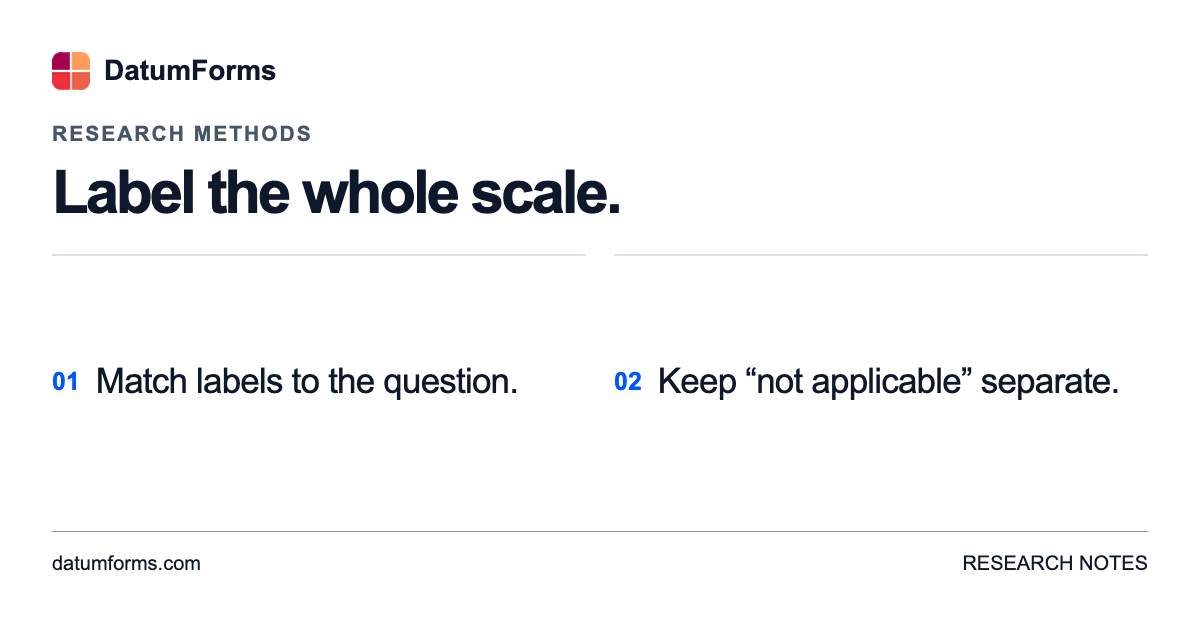
A response scale gives people a way to express a judgement. Its usefulness depends on the question, labels and audience, rather than the number of points alone. For agency teams building questionnaires, choosing five or seven options is only one part of the design.
A Likert-type item commonly asks for agreement with a statement using ordered categories. A multi-item Likert scale combines several related items under a defined scoring approach. One satisfaction question is an ordered rating item; calling it a validated scale does not make it one.
Start with the concept
Decide whether the study needs agreement, satisfaction, frequency, importance or ease. These concepts need different labels. Asking “How often did the delivery arrive on time?” with agree/disagree options mixes the question and answer format.
In an original hypothetical service-team example, “How clear or unclear were the collection instructions?” calls for clarity labels. A separate question about satisfaction with collection calls for satisfaction labels. Keeping them distinct makes it easier to interpret the answers.
Write every response label
For a five-point agreement item, a working set is strongly disagree, disagree, neither agree nor disagree, agree and strongly agree. Check whether respondents understand the distinction between adjacent options. Present the order consistently across similar items.
| Decision | Five-point example | What to check |
|---|---|---|
| Agreement | Strongly disagree to strongly agree | The statement contains one idea |
| Satisfaction | Very dissatisfied to very satisfied | The experience and recall period are clear |
| Frequency | Never to always | People had a relevant opportunity to act |
Seven options may allow finer distinctions, but only if people can use them meaningfully. More points do not automatically produce more accurate answers. Pretest the wording and labels before choosing the format for a tracking programme.
Separate neutral from other situations
A neutral response can mean that a person is neither positive nor negative. “I do not know” means they cannot make the judgement. “Not applicable” means the question does not fit their experience. These should not silently share one code.
For example, someone who collected an order without speaking to staff may be unable to rate staff assistance. Allow a relevant route or a clearly separate option rather than forcing a service rating. In analysis, keep that answer out of the ordered satisfaction calculation and disclose its count.
A scale without a middle option asks people to choose a direction. That can be appropriate for a defined research purpose, but it should be a conscious choice. Do not remove neutral simply to obtain stronger-looking opinions.
Make the response task readable
Long matrix grids can make mobile answering difficult. Check how labels appear without relying on a desktop preview alone. Make sure the question and all options remain visible and understandable at the point of selection.
Read the item aloud during a pretest and ask the respondent to explain what they think it means. If translated versions are needed, review the meaning of both the stem and the labels. A polished translation of the question is insufficient if the scale changes intensity.
Plan scoring before collection
Store the ordered codes and the text labels in the codebook. State whether a reported percentage combines categories and which answers are excluded. Show valid bases and missing or not-applicable counts alongside the distribution.
A mean treats the coded spacing as meaningful; that choice needs justification and should not replace the category distribution. Do not combine several items into an index just because they share five response options. A composite measure needs a reasoned construct and scoring process, with appropriate measurement assessment.
Keep comparisons consistent
If a tracking study changes from five to seven points, renames labels or reverses the order, record the change and reconsider comparability. Reusing the same chart style does not remove the measurement difference.
Finish the review with a short scale specification: concept, item wording, labels in order, exceptional options, scoring rule and pretest issues. That gives the questionnaire writer and analyst the same reference.
Continue the research workflow
- One question one idea
- Survey translation meaning checks
- Survey data analysis group comparisons
Explore current plans , discuss your study or create a business account . For business inquiries: info@datumforms.com .